Extreme tensions

Experimenting with the resistance of material is most fascinating. When mixing metal and paper a tension is created because metal is heavy and the paper that I use only weighs 9 gr./sqm.

Recently I have experimented another type of resistance, namely that of thin Kozo paper on which I heavily apply strong, almost violent strokes of black graphite stick. At times the paper doesn't resist. But when it does the contrast between the fragile paper, the light colour patches and the dark strokes gives me positive emotions.

Harmony can emerge between materials that seem so distant and were not intended for living together. Isn't this also the story of East meeting West.

Connecting cultures

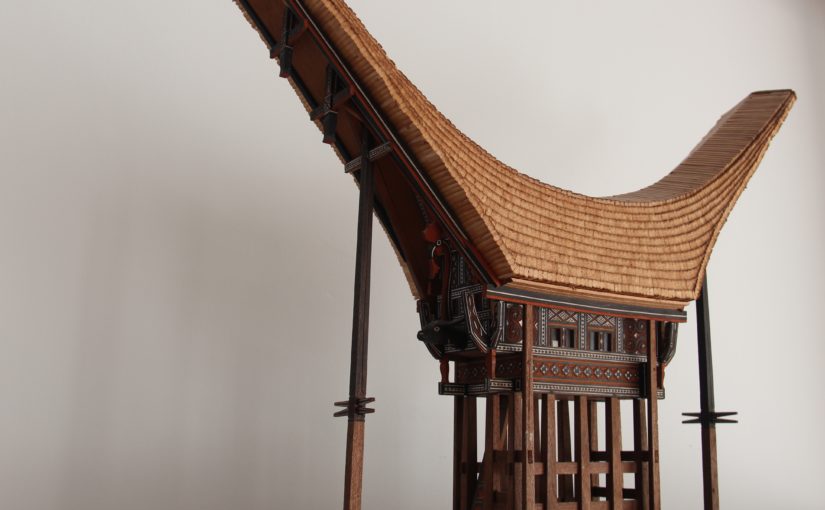
Since my childhood I have lived in the presence of this model of a tongkonan, the typical house of the Toraja in South Sulawesi. My father used to regularly travel to the area to buy and export spices from the harbour of Makassar. He received the model tongkonan from one of his providers.
Tongkonans’ architecture is unique with stilts and a saddle-back roof that provide a kind of rhythm to the building. Decoration is abundant, including painted motifs and a carved buffalo head on the facade, symbol of prosperity and ritual sacrifice. It all looks very well integrated in the local environment and culture.


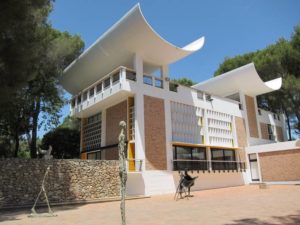
During last week’s visit at the Maeght Foundation in Saint-Paul-de-Vence, I was also struck by the architecture that was perfectly matching the Mediterranean context. Josep Lluis Sert perfectly translated Aimé Maeght’s intentions. The presence of light is essential inside the building as well as in the outdoor courtyards and gardens. The space is rich in sensorial stimulations, both natural and man-made: shapes, colours, sounds, perfumes, textures and of course the wonderful collection of modern and contemporary art.

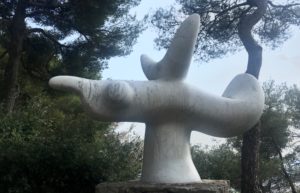
The white roof of the main building reflects the sunlight. I look up towards the trees and the sky. The two thin curved sheets of concrete are stunning and evoke the horns of a bull.

Miro’s sculptures are nearby.

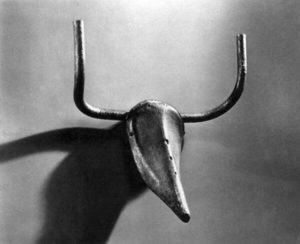
Are bulls a regional archetype? They were no doubt one of Picasso’s preferred subjects. His 1942 Bull's Head made of a bicycle saddle and handlebar inevitably connects with the buffalo head on the tongkonan.

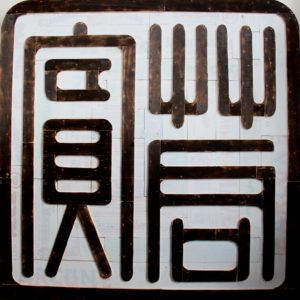
The genesis of my name in Chinese characters

Fascinated by the Oriental cultures I wanted to create another piece that conceptually bridges East and West. I decided that calligraphy would be the common denominator.

A Chinese friend and calligraphy artist offered me a stone seal with my name carved in old Chinese characters. He used the intaglio technique on a surface of 2.2 x 2.2.cm.

With intaglio, the letters appear white while the background is coloured.

The ink is a mix of cinnabar and oil.
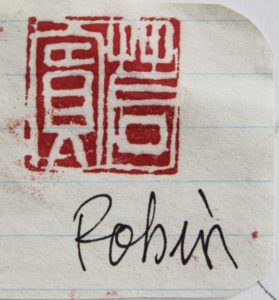
My friend helped me decipher the printed and enlarged version of the seal which I had inserted in my sketchbook. As I wanted the end result to be black characters on a white background, I used tracing paper to invert the white into black letters.
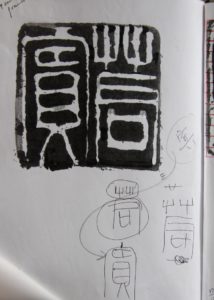
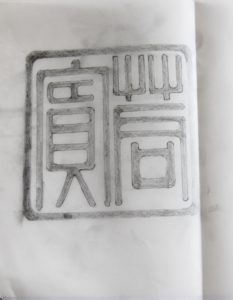
          

The drawing obtained was enlarged to the dimension of the final piece (90x90 cm). 

I could now start producing the artwork.

The sides of wooden fruit and vegetable crates with words printed in the Latin alphabet would form the perfect background. Italy and China share another characteristic; they both have great food. Crates that serve to transport and trade food -and tea in China- were used as a metaphoric representation of this.
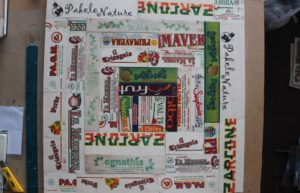
But I wanted the background to be looking white, with the letters subtly coming out. Viewers’ initial impression should be to see black Chinese characters on a white background, and only by looking closer or longer would they see that that background reveals words written in Western calligraphy. So the background was covered with several layers of diluted white paint.
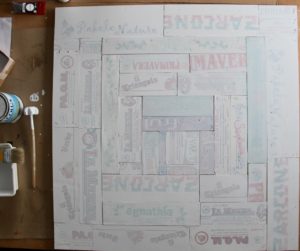
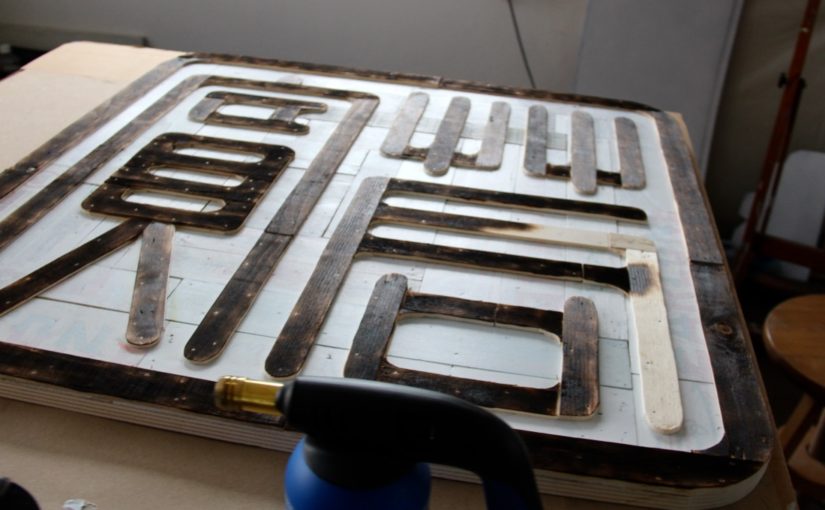
The Chinese letters were reproduced in wood and nailed to the background to form the final shape of the piece.

I used fire to colour the wooden letters in black; this produced the soft and nuanced result which I was looking for.
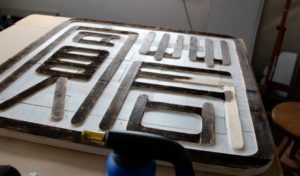
        

And here is the final artwork.